A Practice for the Threshold of Sleep
The Hallway
The hallway is a passageway that we all pass through every night. It's the connection point between our conscious waking mind and our subconscious taking over as we go to sleep. We always pass through it. It's just a matter of whether we notice it, or whether we're too tired and simply slide into sleep.
A practice shared in the first person, with a note under each part on what researchers have found.
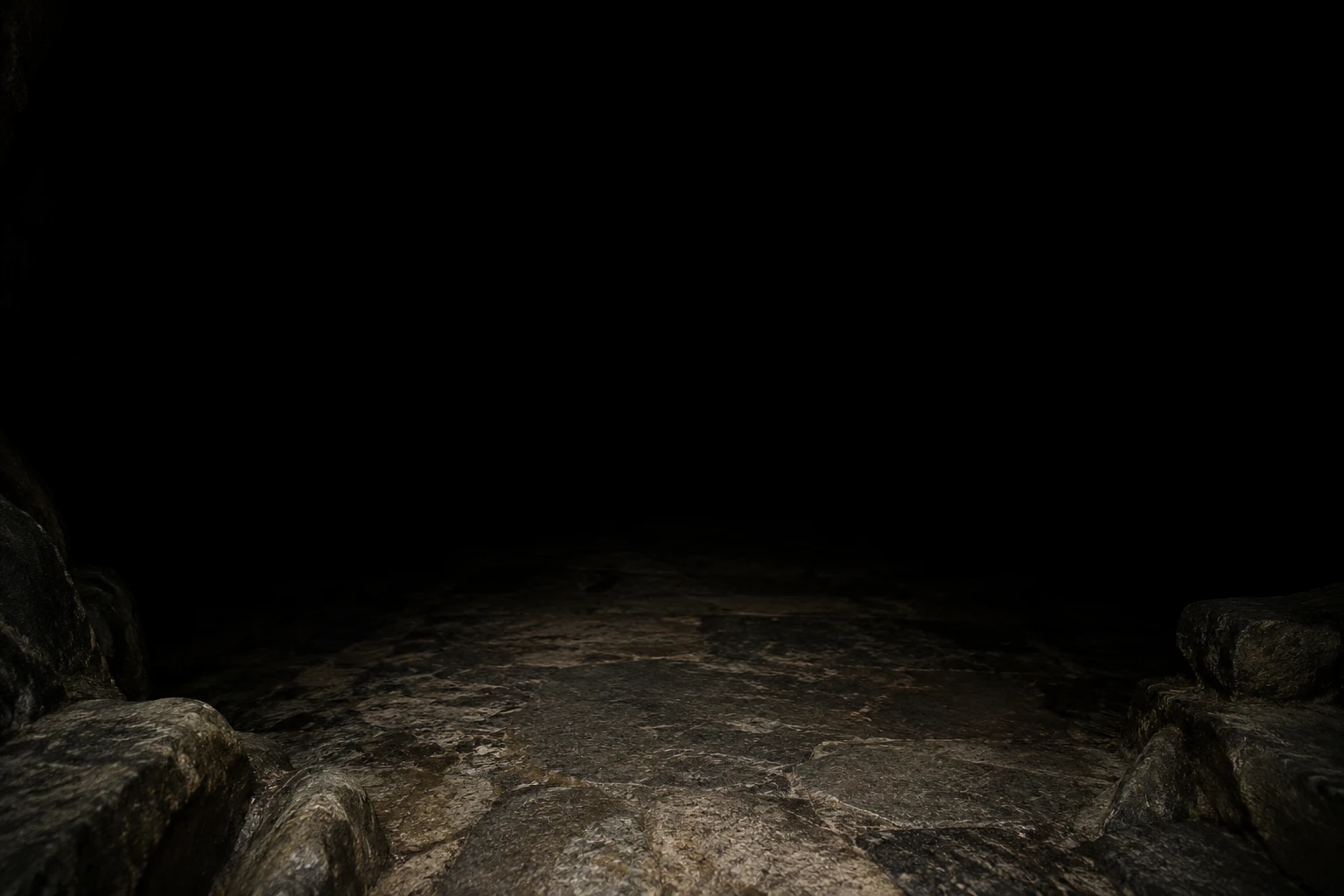
The crowded hallway
A lot of people program themselves in this hallway without recognizing it for what it is. They ruminate on how their day went, or feel gratitude, or think about everything they have to get done tomorrow, front-loading their list of tasks. Or they try to calm their minds, talking themselves down from fear, anxiety, or anticipation. The hallway can get very crowded, and you may not notice all the things you can do in it other than just talk to yourself.
What researchers have found: this passage is called hypnagogia, part of the lightest stage of sleep (N1). Images, voices, and sensations often arise here on their own. Pre-sleep worry and rumination are among the most common reasons people lie awake.
A terminal for your own mind
The hallway is an opportunity to bring things to a kind of terminal interface for your own mind, like going into the root files of your own database. Here is some of what you can do there:
- Recall. You can pull memories back up, if they were thoughtfully packed and archived.
- Ask. Go in with a question, something you want to understand, or a connection you're looking for.
- Set the day. Visualize how your coming day will look and feel, so your mind is primed to recognize that pattern when it appears.
- Turn a project. Bring a creative project and spin it around on a little turntable. You may come away with insights and suggestions you didn't know your mind could make.
What researchers have found: going to sleep holding a question is called dream incubation. In Deirdre Barrett's Harvard study, about half of the students who did this dreamed about their problem, and about a quarter found a solution. In 2021, researchers in Paris found that just fifteen seconds at sleep onset tripled people's chances of a creative insight, the trick Thomas Edison used with a steel ball in his hand.
Packing memories well
Some memories can't be pulled back easily, because you didn't pack them well with sensory input: the light, the textures, the details. Some things you only glanced at, and they didn't stick. But the things that caught your attention, that you doubled back to capture in some way, those are embedded deep in there, and they can come back out. They tend to surface when pattern recognition finds something like them, and it resonates.
A daytime practice: when you want to keep a moment, pause and pack it. Notice the light, a texture, a sound, a smell. Say it to yourself. That small act of attention is what the hallway can find later.
What researchers have found: memories encoded with attention and rich sensory detail are recalled far more easily, a principle known as “levels of processing.” They come back most readily when something in the present matches how they were stored, called “encoding specificity.” That's the resonance that makes a memory surface.
Packing a destination
The visualization and embodied experience: I can experience the outcome arriving. I pack it thoughtfully like a memory I plan to retrieve, only I am packing it as a destination to arrive at and live in. It works. I started with four-leaf clovers, and I'm up to granular details within my life.
Try it: choose something small first. Picture it arriving, and feel it in your body as if it already has. Pack it with the light, the texture, the sound, the feeling in your chest. Then go about your day, and let your pattern recognition find the way to it. Keep doing the work as the driver; the packing tells your attention where to look.
What researchers have found: remembering the past and imagining the future use the same brain network (Daniel Schacter and Donna Rose Addis), so a vividly imagined destination is stored much like a memory. Ecologists call the next part a “search image”: once a bird learns what its prey looks like, it suddenly finds it everywhere. It's the same reason four-leaf clovers start appearing once you've found your first.
The guarded doors
The hallway also protects you. It will tell you there are some memories you aren't allowed to access right now, because your credentials don't allow for the organism's safety if those files were opened in your current state.
Trust that. If something heavy starts to rise, you can always turn back: open your eyes, breathe slowly, feel the bed beneath you. Some doors open only when you're ready, and some are best opened with someone you trust beside you.
Bringing it back to the light
The hallway yields ideas, and they're fleeting, like Elizabeth Gilbert trying to grab the tiger by the tail. There's an ether of possibilities in the hallway that needs to see that you are committed to doing something with it. That commitment is documentation, in a form your waking mind can read.
- Keep a voice recorder within reach. Keep your phone under your pillow and dictate whatever the hallway yields. Tip: put the phone in airplane mode first. Voice memos still record, and your bedroom stays quiet. A notebook works too, but writing tends to pull you much closer to waking.
- Ration your surfacing. Even speaking lifts me out a bit, and I know it, so I save the surfacing for the really important nuggets that won't survive undocumented. Let the rest drift by. Choosing what to bring back is part of the practice.
- Anchor it to the room. If you can't record, look at something you'll see in the morning light and link the idea to it. The object will hand the memory back to you.
- Process it in daylight. Listen to the recording, then write it by hand in a journal. Hearing, reading, and writing it moves the idea through many parts of the brain and makes it yours.
What researchers have found: anchoring an idea to a place or object is the ancient “memory palace” technique. Dream researchers recommend recording immediately on waking, because hypnagogic and dream content fades within minutes.
The border on waking can feel rigid: asleep, then awake. But falling asleep, the hallway sometimes comes to me before I'm even in bed, bringing ideas it wants to work on.
Some people do find a matching hallway on waking, called the hypnopompic state. Lying still for a moment before opening your eyes can help.
What the Hallway Showed Me
The nautilus

Awakening isn't a rise up toward the sky. It is a descent down and into the core of who you are. Room by room, veil by veil, they lift as you go around, descending deeper and deeper into who and what you really are. All the answers are down here. Waiting. Wanting to be found. Everything you ever need is already here.
What researchers and the old stories have found: a living nautilus builds its shell one chamber at a time, sealing each behind it as it grows, and a living thread called the siphuncle runs through every chamber, connecting them all the way to the center. The descent inward is one of humanity's oldest stories. In the Sumerian Descent of Inanna, written down about four thousand years ago, the goddess passes through seven gates into the underworld, giving up a garment or a jewel at each one: veil by veil. Teresa of Ávila's Interior Castle (1577) describes the soul as a castle of many rooms, traveled inward to its center. Carl Jung called the journey into the depths of the psyche the path to the Self.
Other Doors Inward
Guided journeys, or your own hallway?
Many people are now looking for the inner world through plant medicines and guided psychedelic journeys: ayahuasca ceremonies in Peru and Costa Rica, psilocybin retreats, one-on-one sessions with a facilitator, ketamine clinics. Whole businesses have grown up around it. Some people come back changed for the better. Others come back frightened, or hurt. If you're curious, you deserve to walk in with your eyes open.
What the research shows so far
- Psilocybin, the compound in magic mushrooms, has shown strong results in trials for depression, end-of-life distress, and addiction, usually with careful screening, preparation, and two trained guides in the room.
- Ayahuasca has been studied in a small trial for hard-to-treat depression and in large surveys of people who drink it in ceremony. Most describe it as meaningful. Most also report hard physical effects, and some have difficult mental after-effects that last weeks.
- Ketamine is legal by prescription, and a nasal form is approved in the U.S. for treatment-resistant depression. Clinics vary widely in how much care they offer around the session.
- Laws are changing. Oregon (2023) and Colorado (2025) now license supervised psilocybin sessions for adults. The U.S. FDA declined to approve MDMA-assisted therapy in 2024, asking for more evidence.
Before you book anything, ask
- Will they screen me? A careful program asks about your health, your medications, and your family history. One that asks nothing is a warning sign.
- What am I taking now? Ayahuasca combined with many antidepressants can cause serotonin syndrome, a medical emergency. Lithium with psilocybin has been linked to seizures. Some heart and blood pressure conditions don't mix with either.
- Who will be with me, and how were they trained? Ask how many people they guide at once, and what happens if someone has a medical or mental emergency.
- What is their policy on touch and consent? People in altered states are vulnerable. Abuse at retreats and in private sessions has been widely reported. A good guide will tell you the rules before you ask.
- What happens afterward? Integration, the weeks of making sense of what you saw, is where most of the change happens. Ask what support exists once you're home.
- Is this legal where I'll be? And is the substance what they say it is?
If you or a close relative have ever had psychosis or bipolar disorder, research programs screen people out for a reason. Please read Awakening, or psychosis? first.
The doors you already have
A guided journey isn't the only way in. Some of the deepest inner travel needs nothing you can buy: the hallway at the edge of sleep, every single night; slow breathing; drumming and rhythm; long silence; dance; time alone in nature. These doors open more gently, so they take longer, and they never close behind you. Many people who've tried both say the medicine showed them a room, and the daily practices taught them how to live in it.
What researchers have found: Roland Griffiths and colleagues at Johns Hopkins (2006) found psilocybin could bring on mystical experiences that volunteers ranked among the most meaningful of their lives. In 2022 a large trial in The New England Journal of Medicine (Guy Goodwin and colleagues) found a single dose of psilocybin, with support, eased treatment-resistant depression for many participants, while also recording some serious side effects. A small randomized trial in Brazil (Fernanda Palhano-Fontes and colleagues, 2019) found ayahuasca relieved treatment-resistant depression within a day. The Global Ayahuasca Survey of more than 10,000 people (José Carlos Bouso and colleagues, 2022) found most experienced vomiting or other physical effects, more than half had some difficult mental effects afterward, and most still saw the experience as part of a positive process. Ayahuasca contains MAO inhibitors, which is why it is dangerous with many antidepressants. The U.S. approved esketamine nasal spray in 2019. Stanislav Grof developed holotropic breathwork as a drug-free way into the same territory.
For more, see the Library's doorway Guided journeys: what to know before you go and the Edge of Reality Reading Room.
Finding the hallway
Not everyone's hallway is as easy to notice at first. These gentle aids can soften the threshold:
- Slow breathing. A few rounds of 4-7-8 or resonant breathing as you lie down.
- The Earth's pulse. Play the 7.83 Hz pulse softly, eyes closed.
- Dim the evening. Low light, no screens for the last half hour, a warm bath or shower.
- An afternoon rest. Naps reach the hallway quickly, without sliding all the way into deep sleep.
- Wake back to bed. Dream researchers wake after about five hours, stay up quietly for a few minutes, then drift back. The hallway is often wide open on the second descent.
- Hold an intention. As you lie down, say one question or image to yourself, and let go of everything else.
The hallway has been incredibly transformative for me. It seems to be the one chance in everybody's day to dive deeper, and maybe one of the first places we can go to change the way we think about thinking, about our lives, and about how much of our days we can shape. You don't need to have read a single book on it. There's something really magical here, and tremendous potential in this liminal space.
To go deeper, visit The Liminal Reading Room or the Library's threshold of sleep doorway.